Java多线程怎么理解
1 线程池的优势
总体来说,线程池有如下的优势:
(1)降低资源消耗。通过重复利用已创建的线程降低线程创建和销毁造成的消耗。
(2)提高响应速度。当任务到达时,任务可以不需要等到线程创建就能立即执行。
(3)提高线程的可管理性。线程是稀缺资源,如果无限制的创建,不仅会消耗系统资源,还会降低系统的稳定性,使用线程池可以进行统一的分配,调优和监控。
2 线程池的使用
线程池的真正实现类是 ThreadPoolExecutor,其构造方法有如下4种:
public ThreadPoolExecutor(int corePoolSize, int maximumPoolSize, long keepAliveTime, TimeUnit unit, BlockingQueueworkQueue) { this(corePoolSize, maximumPoolSize, keepAliveTime, unit, workQueue, Executors.defaultThreadFactory(), defaultHandler); } public ThreadPoolExecutor(int corePoolSize, int maximumPoolSize, long keepAliveTime, TimeUnit unit, BlockingQueue workQueue, ThreadFactory threadFactory) { this(corePoolSize, maximumPoolSize, keepAliveTime, unit, workQueue, threadFactory, defaultHandler); } public ThreadPoolExecutor(int corePoolSize, int maximumPoolSize, long keepAliveTime, TimeUnit unit, BlockingQueue workQueue, RejectedExecutionHandler handler) { this(corePoolSize, maximumPoolSize, keepAliveTime, unit, workQueue, Executors.defaultThreadFactory(), handler); } public ThreadPoolExecutor(int corePoolSize, int maximumPoolSize, long keepAliveTime, TimeUnit unit, BlockingQueue workQueue, ThreadFactory threadFactory, RejectedExecutionHandler handler) { if (corePoolSize < 0 || maximumPoolSize <= 0 || maximumPoolSize < corePoolSize || keepAliveTime < 0) throw new IllegalArgumentException(); if (workQueue == null || threadFactory == null || handler == null) throw new NullPointerException(); this.corePoolSize = corePoolSize; this.maximumPoolSize = maximumPoolSize; this.workQueue = workQueue; this.keepAliveTime = unit.toNanos(keepAliveTime); this.threadFactory = threadFactory; this.handler = handler; }
可以看到,其需要如下几个参数:
corePoolSize(必需):核心线程数。默认情况下,核心线程会一直存活,但是当将 allowCoreThreadTimeout 设置为 true 时,核心线程也会超时回收。
maximumPoolSize(必需):线程池所能容纳的最大线程数。当活跃线程数达到该数值后,后续的新任务将会阻塞。
keepAliveTime(必需):线程闲置超时时长。如果超过该时长,非核心线程就会被回收。如果将 allowCoreThreadTimeout 设置为 true 时,核心线程也会超时回收。
unit(必需):指定 keepAliveTime 参数的时间单位。常用的有:TimeUnit.MILLISECONDS(毫秒)、TimeUnit.SECONDS(秒)、TimeUnit.MINUTES(分)。
workQueue(必需):任务队列。通过线程池的 execute() 方法提交的 Runnable 对象将存储在该参数中。其采用阻塞队列实现。
threadFactory(可选):线程工厂。用于指定为线程池创建新线程的方式。
线程池的使用流程如下:
// 创建线程池
ThreadPoolExecutor threadPool = new ThreadPoolExecutor(CORE_POOL_SIZE,
                                             MAXIMUM_POOL_SIZE,
                                             KEEP_ALIVE,
                                             TimeUnit.SECONDS,
                                             sPoolWorkQueue,
                                             sThreadFactory);
// 向线程池提交任务
threadPool.execute(new Runnable() {
    @Override
    public void run() {
        ... // 线程执行的任务
    }
});
// 关闭线程池
threadPool.shutdown(); // 设置线程池的状态为SHUTDOWN,然后中断所有没有正在执行任务的线程
threadPool.shutdownNow(); // 设置线程池的状态为 STOP,然后尝试停止所有的正在执行或暂停任务的线程,并返回等待执行任务的列表
3 线程池的工作原理
下面来描述一下线程池工作的原理,同时对上面的参数有一个更深的了解。其工作原理流程图如下:
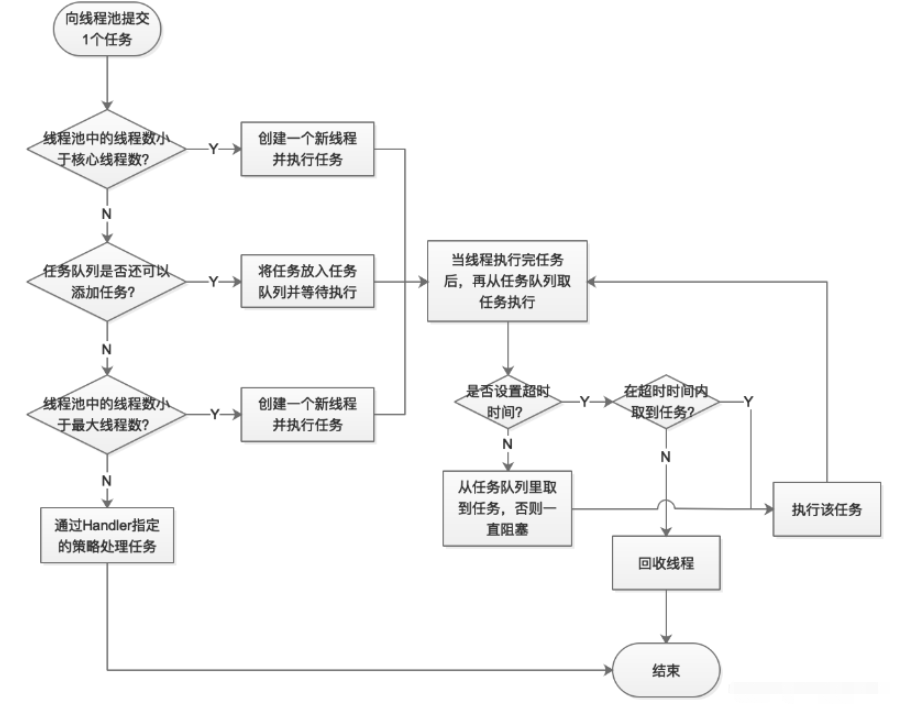
通过上图,相信大家已经对所有参数有个了解了。下面再对任务队列、线程工厂和拒绝策略做更多的说明。
4 线程池的参数
4.1 任务队列(workQueue)
任务队列是基于阻塞队列实现的,即采用生产者消费者模式,在 Java 中需要实现 BlockingQueue 接口。但 Java 已经为我们提供了 7 种阻塞队列的实现:
ArrayBlockingQueue:一个由数组结构组成的有界阻塞队列(数组结构可配合指针实现一个环形队列)。
LinkedBlockingQueue: 一个由链表结构组成的有界阻塞队列,在未指明容量时,容量默认为 Integer.MAX_VALUE。
PriorityBlockingQueue: 一个支持优先级排序的无界阻塞队列,对元素没有要求,可以实现 Comparable 接口也可以提供 Comparator 来对队列中的元素进行比较。跟时间没有任何关系,仅仅是按照优先级取任务。
DelayQueue:类似于PriorityBlockingQueue,是二叉堆实现的无界优先级阻塞队列。要求元素都实现 Delayed 接口,通过执行时延从队列中提取任务,时间没到任务取不出来。
SynchronousQueue: 一个不存储元素的阻塞队列,消费者线程调用 take() 方法的时候就会发生阻塞,直到有一个生产者线程生产了一个元素,消费者线程就可以拿到这个元素并返回;生产者线程调用 put() 方法的时候也会发生阻塞,直到有一个消费者线程消费了一个元素,生产者才会返回。
LinkedBlockingDeque: 使用双向队列实现的有界双端阻塞队列。双端意味着可以像普通队列一样 FIFO(先进先出),也可以像栈一样 FILO(先进后出)。
LinkedTransferQueue: 它是ConcurrentLinkedQueue、LinkedBlockingQueue 和 SynchronousQueue 的结合体,但是把它用在 ThreadPoolExecutor 中,和 LinkedBlockingQueue 行为一致,但是是无界的阻塞队列。
注意有界队列和无界队列的区别:如果使用有界队列,当队列饱和时并超过最大线程数时就会执行拒绝策略;而如果使用无界队列,因为任务队列永远都可以添加任务,所以设置 maximumPoolSize 没有任何意义。
4.2 线程工厂(threadFactory)
线程工厂指定创建线程的方式,需要实现 ThreadFactory 接口,并实现 newThread(Runnable r) 方法。该参数可以不用指定,Executors 框架已经为我们实现了一个默认的线程工厂:
/**
 * The default thread factory.
 */
private static class DefaultThreadFactory implements ThreadFactory {
    private static final AtomicInteger poolNumber = new AtomicInteger(1);
    private final ThreadGroup group;
    private final AtomicInteger threadNumber = new AtomicInteger(1);
    private final String namePrefix;

    DefaultThreadFactory() {
        SecurityManager s = System.getSecurityManager();
        group = (s != null) ? s.getThreadGroup() :
                              Thread.currentThread().getThreadGroup();
        namePrefix = "pool-" +
                      poolNumber.getAndIncrement() +
                     "-thread-";
    }

    public Thread newThread(Runnable r) {
        Thread t = new Thread(group, r,
                              namePrefix + threadNumber.getAndIncrement(),
                              0);
        if (t.isDaemon())
            t.setDaemon(false);
        if (t.getPriority() != Thread.NORM_PRIORITY)
            t.setPriority(Thread.NORM_PRIORITY);
        return t;
    }
}
4.3 拒绝策略(handler)
当线程池的线程数达到最大线程数时,需要执行拒绝策略。拒绝策略需要实现 RejectedExecutionHandler 接口,并实现 rejectedExecution(Runnable r, ThreadPoolExecutor executor) 方法。不过 Executors 框架已经为我们实现了 4 种拒绝策略:
AbortPolicy(默认):丢弃任务并抛出 RejectedExecutionException 异常。
CallerRunsPolicy:由调用线程处理该任务。
DiscardPolicy:丢弃任务,但是不抛出异常。可以配合这种模式进行自定义的处理方式。
DiscardOldestPolicy:丢弃队列最早的未处理任务,然后重新尝试执行任务。
5 功能线程池
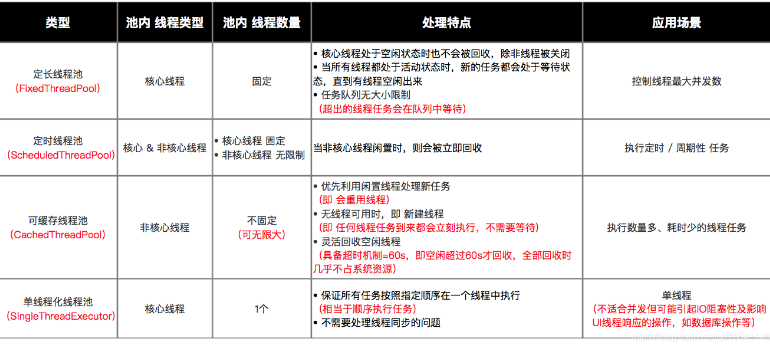
嫌上面使用线程池的方法太麻烦?其实Executors已经为我们封装好了 4 种常见的功能线程池,如下:
定长线程池(FixedThreadPool)
定时线程池(ScheduledThreadPool )
可缓存线程池(CachedThreadPool)
单线程化线程池(SingleThreadExecutor)
5.1 定长线程池(FixedThreadPool)
创建方法的源码:
public static ExecutorService newFixedThreadPool(int nThreads) {
    return new ThreadPoolExecutor(nThreads, nThreads,
                                  0L, TimeUnit.MILLISECONDS,
                                  new LinkedBlockingQueue());
}
public static ExecutorService newFixedThreadPool(int nThreads, ThreadFactory threadFactory) {
    return new ThreadPoolExecutor(nThreads, nThreads,
                                  0L, TimeUnit.MILLISECONDS,
                                  new LinkedBlockingQueue(),
                                  threadFactory);
} 特点:只有核心线程,线程数量固定,执行完立即回收,任务队列为链表结构的有界队列。
应用场景:控制线程最大并发数。
使用示例:
// 1. 创建定长线程池对象 & 设置线程池线程数量固定为3
ExecutorService fixedThreadPool = Executors.newFixedThreadPool(3);
// 2. 创建好Runnable类线程对象 & 需执行的任务
Runnable task =new Runnable(){
  public void run() {
     System.out.println("执行任务啦");
  }
};
// 3. 向线程池提交任务
fixedThreadPool.execute(task);
5.2 定时线程池(ScheduledThreadPool )
创建方法的源码:
private static final long DEFAULT_KEEPALIVE_MILLIS = 10L;

public static ScheduledExecutorService newScheduledThreadPool(int corePoolSize) {
    return new ScheduledThreadPoolExecutor(corePoolSize);
}
public ScheduledThreadPoolExecutor(int corePoolSize) {
    super(corePoolSize, Integer.MAX_VALUE,
          DEFAULT_KEEPALIVE_MILLIS, MILLISECONDS,
          new DelayedWorkQueue());
}

public static ScheduledExecutorService newScheduledThreadPool(
        int corePoolSize, ThreadFactory threadFactory) {
    return new ScheduledThreadPoolExecutor(corePoolSize, threadFactory);
}
public ScheduledThreadPoolExecutor(int corePoolSize,
                                   ThreadFactory threadFactory) {
    super(corePoolSize, Integer.MAX_VALUE,
          DEFAULT_KEEPALIVE_MILLIS, MILLISECONDS,
          new DelayedWorkQueue(), threadFactory);
}特点:核心线程数量固定,非核心线程数量无限,执行完闲置 10ms 后回收,任务队列为延时阻塞队列。
应用场景:执行定时或周期性的任务。
使用示例:
// 1. 创建 定时线程池对象 & 设置线程池线程数量固定为5
ScheduledExecutorService scheduledThreadPool = Executors.newScheduledThreadPool(5);
// 2. 创建好Runnable类线程对象 & 需执行的任务
Runnable task =new Runnable(){
  public void run() {
     System.out.println("执行任务啦");
  }
};
// 3. 向线程池提交任务
scheduledThreadPool.schedule(task, 1, TimeUnit.SECONDS); // 延迟1s后执行任务
scheduledThreadPool.scheduleAtFixedRate(task,10,1000,TimeUnit.MILLISECONDS);// 延迟10ms后、每隔1000ms执行任务
5.3 可缓存线程池(CachedThreadPool)
创建方法的源码:
public static ExecutorService newCachedThreadPool() {
    return new ThreadPoolExecutor(0, Integer.MAX_VALUE,
                                  60L, TimeUnit.SECONDS,
                                  new SynchronousQueue());
}
public static ExecutorService newCachedThreadPool(ThreadFactory threadFactory) {
    return new ThreadPoolExecutor(0, Integer.MAX_VALUE,
                                  60L, TimeUnit.SECONDS,
                                  new SynchronousQueue(),
                                  threadFactory);
} 特点:无核心线程,非核心线程数量无限,执行完闲置 60s 后回收,任务队列为不存储元素的阻塞队列。
应用场景:执行大量、耗时少的任务。
使用示例:
// 1. 创建可缓存线程池对象
ExecutorService cachedThreadPool = Executors.newCachedThreadPool();
// 2. 创建好Runnable类线程对象 & 需执行的任务
Runnable task =new Runnable(){
  public void run() {
     System.out.println("执行任务啦");
  }
};
// 3. 向线程池提交任务
cachedThreadPool.execute(task);
5.4 单线程化线程池(SingleThreadExecutor)
创建方法的源码:
public static ExecutorService newSingleThreadExecutor() {
    return new FinalizableDelegatedExecutorService
        (new ThreadPoolExecutor(1, 1,
                                0L, TimeUnit.MILLISECONDS,
                                new LinkedBlockingQueue()));
}
public static ExecutorService newSingleThreadExecutor(ThreadFactory threadFactory) {
    return new FinalizableDelegatedExecutorService
        (new ThreadPoolExecutor(1, 1,
                                0L, TimeUnit.MILLISECONDS,
                                new LinkedBlockingQueue(),
                                threadFactory));
} 特点:只有 1 个核心线程,无非核心线程,执行完立即回收,任务队列为链表结构的有界队列。
应用场景:不适合并发但可能引起 IO 阻塞性及影响 UI 线程响应的操作,如数据库操作、文件操作等
使用示例:
// 1. 创建单线程化线程池
ExecutorService singleThreadExecutor = Executors.newSingleThreadExecutor();
// 2. 创建好Runnable类线程对象 & 需执行的任务
Runnable task =new Runnable(){
  public void run() {
     System.out.println("执行任务啦");
  }
};
// 3. 向线程池提交任务
singleThreadExecutor.execute(task);
5.5 对比